
 781-325-1095







Musika Quick Stats
25 Years
Since We Started
41,456+
Happy Customers
10,769
Cities with Students
3,123
Teachers in Network
Lesson Special - Up to 20% OFF! Get Started Now with a Risk-Free Trial!
Here are just a few of the many teachers offering Piano lessons in Quincy . Whether you are looking for beginner guitar lessons for your kids, or are an adult wanting to improve your skills, the instructors in our network are ready to help you now!
Instruments: Piano Voice
As an approachable and experienced instructor, I am eager to offer a comprehensive approach to music education and enjoyment. From the fundamental theory concepts to the art of performance confidence and stage presence, my primary goal is bring the elements together to help create passionate, skilled, and enthusiastic musicians of all ages. I encourage sharing of musical ideas, and we will work together to set goals that motivate and inspire students. Read More
Instruments: Piano Guitar
I approach teaching on an individual level - what's important to me is why you want to learn to play music. Then I can help you get there. Some adults have very different goals and expectations for wanting to add music to their life, than say a school-age student. I have had students who wanted to be virtuosos, and some who merely wanted to experience playing favorite songs without learning reading and theory. Read More
Instruments: Piano Guitar Drums Bass Guitar French Horn
I find that it drives the student to learn the instrument for himself. And as the student wants, more and more, to prove that he can "beat the instrument," he begins to work at it in ways that I can't teach. Learning an instrument is more than showing up for one hour each week. Practice is everything. I feel that my methodology encourages students to take on the instrument head on and learn how to solve problems on their own so that they can practice and improve more quickly. Read More
Instruments: Piano Guitar Drums Bass Guitar Ukulele Double Bass Music Keyboard Electric Guitar Acoustic Guitar
I have developed a method for guitar students of all ages to quickly learn chords and scales so that they can not only learn the chord progression to songs, they can also find the correct scale to "solo" and improvise over them. Once the chord structure and scale are learned I accompany the student, playing along with them so that they can practice playing with another musician and soloing. I have also developed a full curriculum for teaching bass guitar to all ages and skill levels. Read More
Instruments: Piano Guitar Voice Violin Viola Ukulele Music Keyboard Acoustic Guitar
For beginner piano students, I have found the Faber Piano Adventures books to be quite successful. For other lessons, I try to tailor them to each student and find materials that fit with their unique music goals. I have drawn from a variety of music resources, as well as my own knowledge, to help students learn through their own unique way of thinking. I believe it is important to build off of the skills that students already have, and to find ways to support them as they grow in other areas. Read More
Instruments: Piano Music Keyboard
My experience teaching started when I was 16, a junior in high school, where I taught a few students each week. I then went off to junior college where I studied voice, piano performance, and vocal jazz. I had the amazing opportunity to perform Saint Sean's Piano Concerto No. 2 Mvmt III. in g minor with the orchestra. I then began my studies at Sonoma State University where I earned my Bachelor's degree. Read More
Instruments: Piano Guitar Clarinet Bass Guitar Synthesizer Recorder
Every student is different and has their own taste in music. I hope to help every student find the same joy in playing music as they do in their listening. This requires two important aspects: development of technique/facility on one's instrument, and a sense of acheiving one's personal musical goals. I try to give every student basic exercises to work on to develop facility on their given instrument, but I tailor those exercises towards music that the student has expressed interest in learning. Read More
Instruments: Piano Saxophone Flute Clarinet Keyboard
Why did you choose your primary instrument?
I first learned the basics of playing the clarinet and played in school bands from 4th grade until middle school. When I was in 7th grade, a friend of mine let me try his saxophone and I found it was easier to express myself on that instrument, so I switched. While studying to become a music teacher, I realized that playing both instruments would help me the most in my career, so I began to practice the clarinet again as well.
What advice do you have about practicing effectively?
Schedule two or three times during the week outside of the private lesson where you can practice without interruption. Make sure you have a practice area where you can keep your metronome, reeds, music stand, etc. in one place. Develop a warmup routine that is consistent and touches on all the areas of breathing, embouchure, posture, technical exercises, articulation, and so forth, before moving on to literature, tunes, or band music. Keep a practice log in which you note when you practice and what you practiced and for how long.
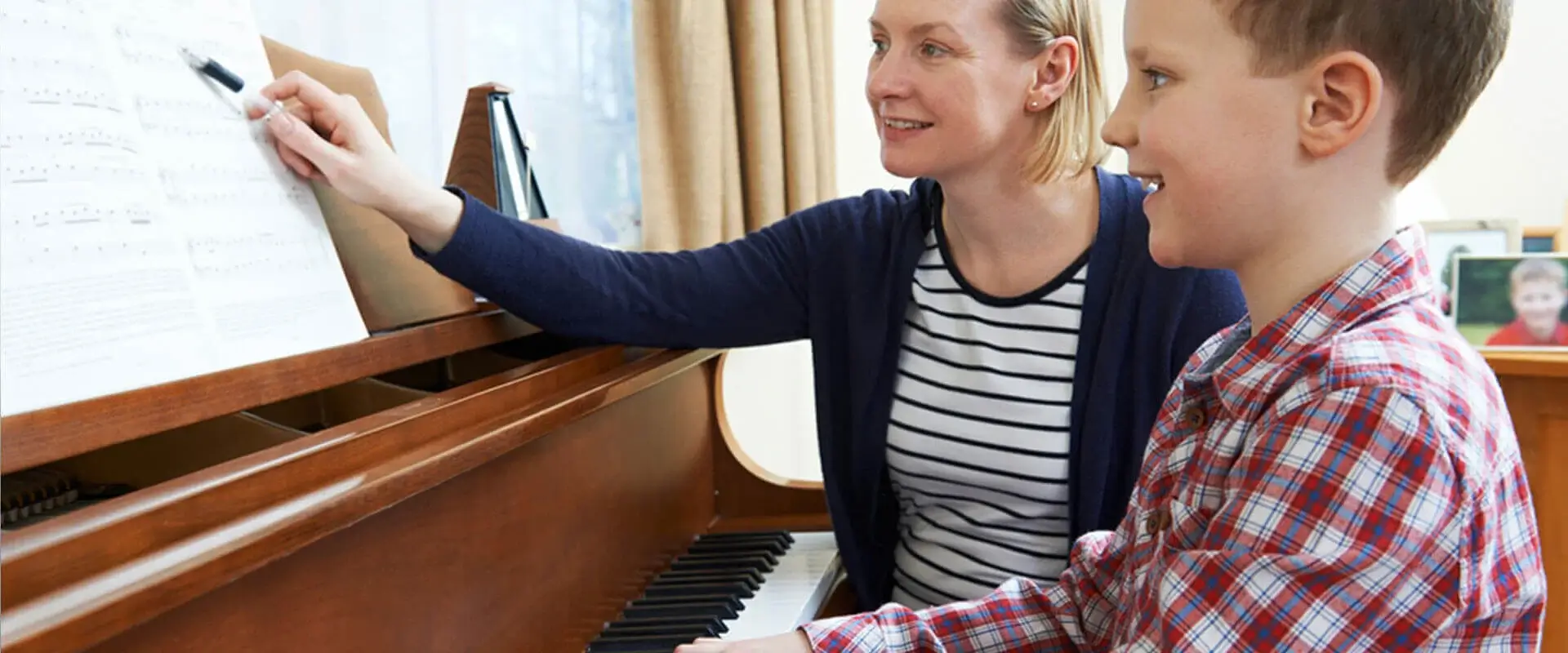
How do I know if my child is ready to start lessons?
It’s a good question, and I am going to touch on 3 things to consider before starting.
1. Can Your Child Focus For Short Periods Of Time On A Task?
If a bit of focused concentration is there, we can build on that attention span. At first we might be stringing together little tiny bites of concentration, with built in tasks in between. Over time we can stretch that out and your child will learn to focus and concentrate for longer periods of time.
As long as some concentration is happening you are on the right track for getting started.
2. Will Your Child Interact With Another Adult Who Is Giving Them Instructions?
For many students this is the first time they will work in a close one on one interaction with someone who is not a parent or relative. Depending on the child, this may be no big deal or may be something that you will need to work on before lessons start.
3. The Most Important Consideration For If Your Child Is Ready To Start Music Lessons Is:
Are You The Parent Ready To Undertake Music Lessons With Your Child?
Research shows that one of the biggest indicators of a child’s long term success in music is actually the parents long term commitment to music. I think it’s because we approach activities our children are “trying out” much differently than those we are committed to them doing long term. We put more time and emphasis on helping them form habits and stay disciplined about something we want them to still be doing years from now, for example.
Music lessons, and especially practicing with your child daily, takes a lot of time as a parent.
You will have a wonderful opportunity to bond with your child, understand how they learn, and help them to flourish and thrive. You will also need to find to make room in your family’s schedule to practice and perhaps sacrifice time for other things in order to practice daily with your child.
25 Years
Since We Started
41,456+
Happy Customers
10,769
Cities with Students
3,123
Teachers in Network
Trusted as the industry leader, for over 21 years the teachers in our network have been providing Piano lessons in Quincy to students of all ages and abilities.
We'll then reach out to the teachers for you.
Schedule the risk-free trial lesson directly with the teacher.
Continue with that teacher or try someone else.